IN THE BEGINNING – ORIGINS AND INFLUENCES

Origins of Megagames

The early prototypes of what were to become megagames started with Paddy Griffith in the later 1970s and early 1980s. As a senior lecturer at the Royal Military Academy Sandhurst, Paddy ran large multiplayer wargames for the students and my early involvement with Paddy and large, multiplayer multi-team games was being invited to take part as a member of the control teams.
The first game actually called a megagame was Paddy’s ‘Memphis Mangler‘ Vietnam wargame played in April 1982 with about 30 players, though both Paddy and others (such as the Chestnut Lodge Wargames Group in South London) had been running games that would by our modern definition qualify as a megagame these days. It was Andy Callan who coined the name, saying something like “this isn’t just a wargame, it is some sort of … MEGA-game”

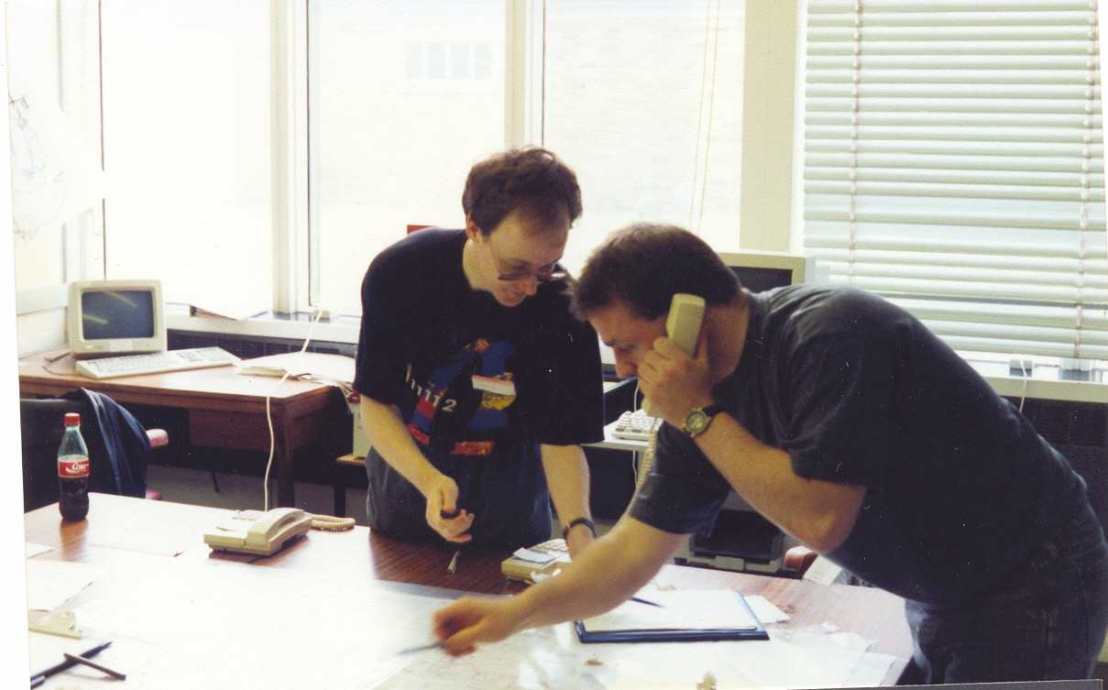
scan0036-1
Megagame Control Team – Army Staff College, Montgomery Wing in the early 1990s

From the outset, for recreational wargamers, the whole idea of these large multi-player games was both startling and very exciting. At that time There was nothing else like it outside the military training environment (and even in the military training environment they were a lot less open to emerging game-play), and those early games by Paddy and, later, Andy Grainger were exceptionally inspirational and really started the development of megagames as we now understand them.
There has, of course been mainstream hobby wargames involving lots of people – but these generally lacked the hierarchies and the team interaction that characterises megagames. Wargames with large numbers of toy soldiers with two sides playing a simple game on the table top (or floor) facing each other would not generally qualify as a megagame.

Through my contact with Paddy I was able to not only see his idea of large wargames put into practice, but also I was invited to help him run operational wargames for cadets at the Sandhurst Academy, and to help Paddy set up and run a wargame for Southern TV’s series Invasion Road in 1979, where we ran a fictitious Warsaw Pact / NATO wargame using the Royal United Services Institute in Whitehall as a venue and memorably with the late Brigadier Peter Young as the NATO supreme commander!

The early 1980s saw a series of imaginative, sometimes quirky, sometimes astonishing megagames run by Paddy, with the help of others. I thoroughly recommend Paddy’s book, Sprawling Wargames for an insight into his philosophy of larger wargames with multiple players. Paddy’s games covered a wide range of historical subjects the French Revolution (in a game called ‘Sans Culottes‘). the 1918 Kaiserschlact Offensive, the Peninsular War (in a game called ‘Tajo‘), the convoy war in the Atlantic (‘Western Approaches’), the Franco-Austrian war (‘Novi‘ in conjunction with myself), and the opening moves of WW1 (‘Guns of August‘). Paddy brought a professional historian’s attention to detail and a truly creative instinct for games to his megagames.

These early games inspired Andy Grainger to turn his own highly respected and thorough research skills to the genre, and he produced a very successful series of well-written and structured world war two historical megagames, based around the Battle of Kirovograd.
scan0107-2
Megagaming at the Army Staff College, Montgomery Wing, in the early 1990s

Andy’s example proved the final inspiration for me to start running my own games on the same scale and my first megagame “Blood & Thunder” – a huge 60 player piratical naval /role playing game – in 1987. This was historical, and loosely based on Morgan’s fleet raids on the Spanish Main. It had perhaps a higher degree of role playing and plot than previous megagames, and was built around the team concept, with each team representing a ship’s crew. The main action was using model ships on a huge floor model in the Woolwich Hall in Sandhurst.

This kicked off a long run of games that continues to this day.

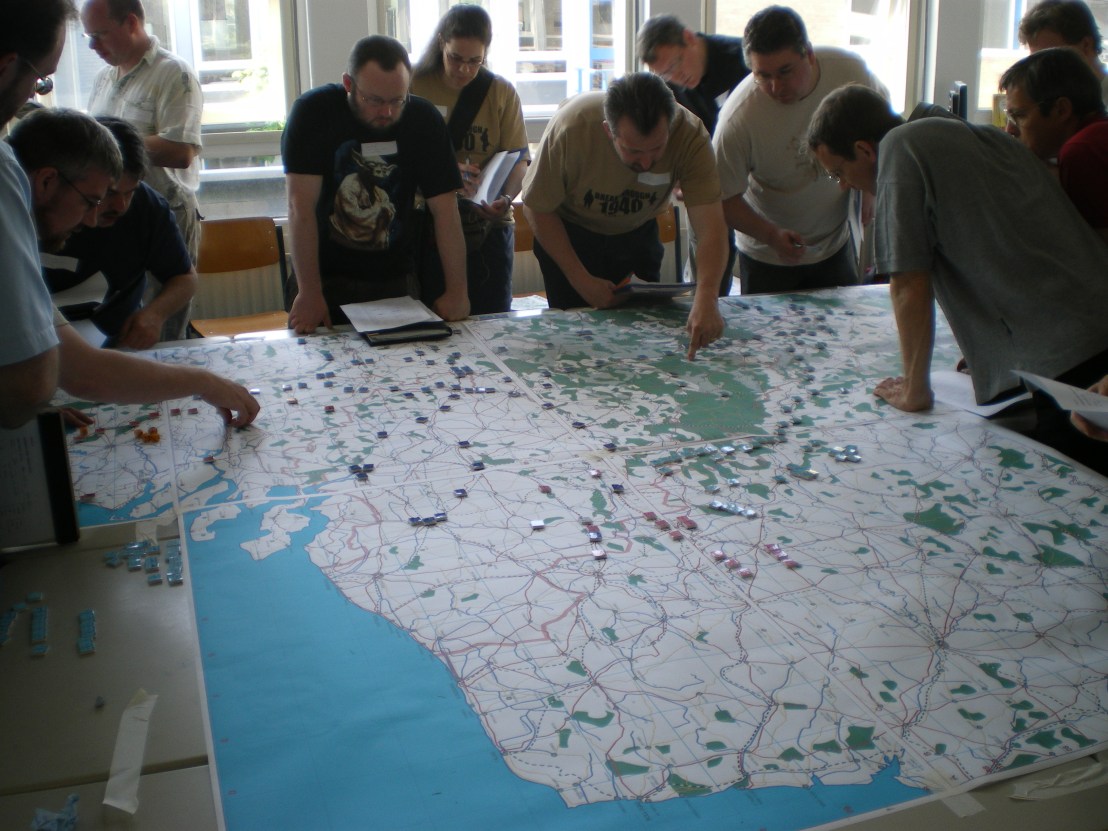
The early 1990s saw the first properly collaborative game design, with a megagame called Springtime for Hitler, and the creation of the loose association of megagame designers, now known as Megagame Makers. Springtime was 180 player game about the campaign in France and the Low Countries in 1940. Graham Attfield, Brian Cameron, Andy Grainger, Steve Hale, Terry Martin, and myself put together a large and complex military / political game, and set the scene for future collaborations in megagame design.
We established that it didn’t necessarily need a single talented and enthusiastic individual to produce a successful game, and that notion probably encouraged many of today’s designers to take the plunge, at first, in collaboration with others.

Other Influences

Of course, in the professional wargaming field (in government and defence circles) the multi-player political / operational game has been in existence for decades or longer . There were (and are) many elaborate wargames played by the US military and the RAND Corporation during the late 1950s to the 1980s, and these were (and still are) used to inform policy within government.
I was fortunate, in the 1980s, to be able to access quite a lot of the literature of those games through the Ministry of Defence library.
In addition there have been political and crisis games run in many University politics departments, and these routinely form part of the study programmes.
Many of our megagamers (and some designers) have had experience of these and bring that experience to their game designs.

In the UK hobby wargames world, the megagame concept came about about as a cross-over from Dr Paddy Griffith and some members of the group he founded in 1980, “Wargame Developments”.
The initial idea was to use the techniques of the military command post exercise (CPX) in playing hobby wargames. Paddy experimented successfully with the multi-room wargames using closed game systems, and ran a number of games for non-military audiences – most notably his game of ‘Sealion‘ and his NATO / Warsaw Pact game for the 1979 TV series ‘Invasion Road‘ for Southern Television.

Although the detail and the way these were put into practice has altered over the years – the basic tenets form the key central characteristics in many of the modern megagames.
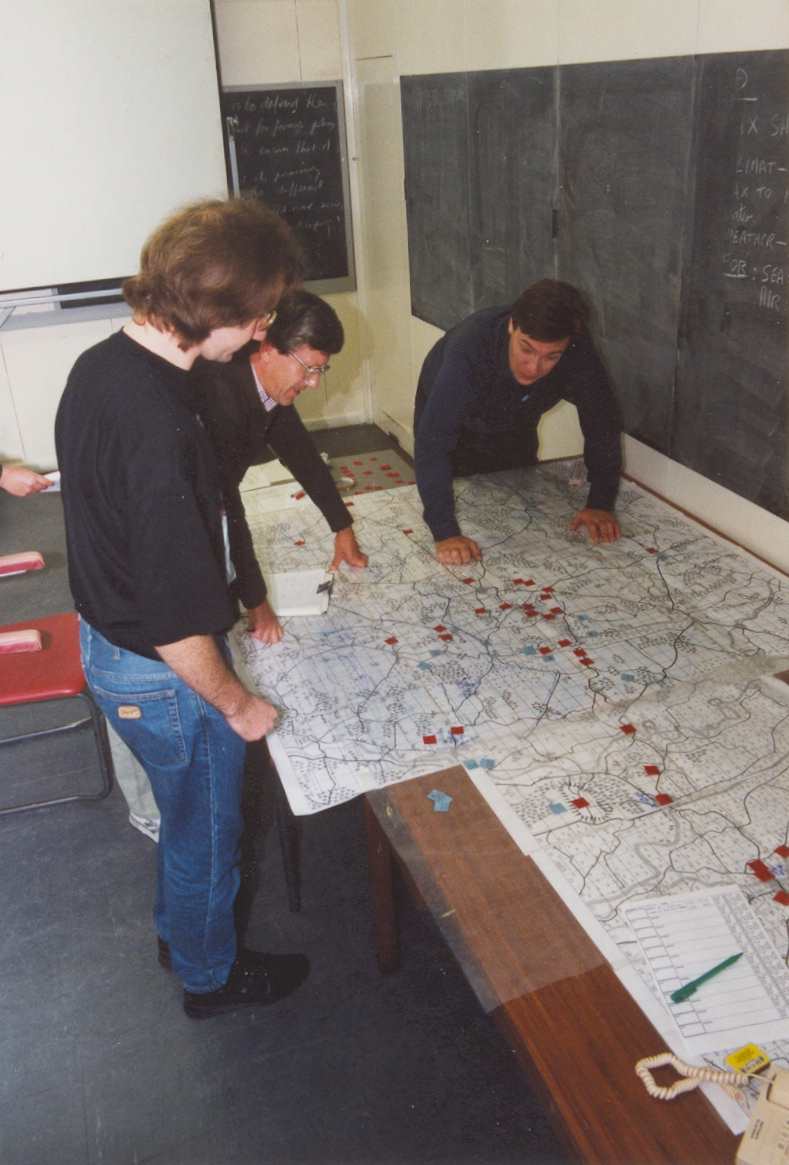
scan0072-2
Operation Market Garden WW2 Megagame in 1988

Board game designs have been influential too – particularly where political and economic factors are in play. The growth of the commercial board games over the last decade has been meteoric – particularly the popularity of euro games. And this, coupled with the expansion of social board gaming has created a demographic of ‘game literati’ who form a large proportion of the present population of megagamers.

Also Kriegspiel has been important Bill Leeson’s involvement in bringing the modern Kriegspiel back into the light, and the natural similarities between the Kriegspiel and the operational megagame.
The original Reiswitz Kriegspiel has much in common with the modern operational megagame – they both involve maps gaming, and the movement of units over time, hidden movement and command and control structures. Players of kriegspiel often migrate easily to operational megagames because the feel is very similar.
Computer games and especially Real Time Strategy (RTS) games have been influential for a number of games. The computer game has massively altered from its early pixillated simplicity on the BBC, Commodore 64 or Spectrum. Even then, the classic game ‘Arnhem’ game by SSI for the Spectrum was the initial inspiration of the early operational world war 2 megagame ‘Operation Market Garden‘.
Modern computer games have many of the features that can be found in the megagame – once you get behind the photo-realistic graphics. Games which encourage multiplayer interaction in particular team play – for example famous MMORPGs such as World of Warcraft – have encouraged team-based play and even hierarchies of command and control have evolved, though this is not a central tenet of the game design.
Familiarity with cooperative play is growing, and the best example of this is Artemis, the starship bridge crew simulator. This creates, over a computer network, an excellent real-time simulation of a starship bridge with players operating key control stations and who must communicate and cooperate to run their ship. The system even allows up to six ships to cooperate, necessitating a hierarchy and an admiral and/or squadron commanders.

And, of course, most recently, the well-known Watch the Skies series of megagames was inspired by the 1994 classic game UFO Enemy Unknown developed by Mythos Games and MicroProse.

Game Theory has had its place too. As the megagame idea developed, so designers started to draw in ideas from game theory – not just the mathematical aspects, but more qualitative ideas concerned with the psychology and sociology of game play.
This has been supplemented by ideas drawn from more recent literature on game design that has arisen from the growth of game design as a subject taught at university (on the back of the explosion in the computer games industry). Academic professors of Game Design are, as professors do, writing about their subject in extremely interesting, and entertaining, ways and the literature is growing daily.  I particularly like Rules of Play  by Katie Salen   and Eric Zimmerman.. Also recommended are The Art of Game Design: A book of lenses and A Theory of Fun for Game Design.
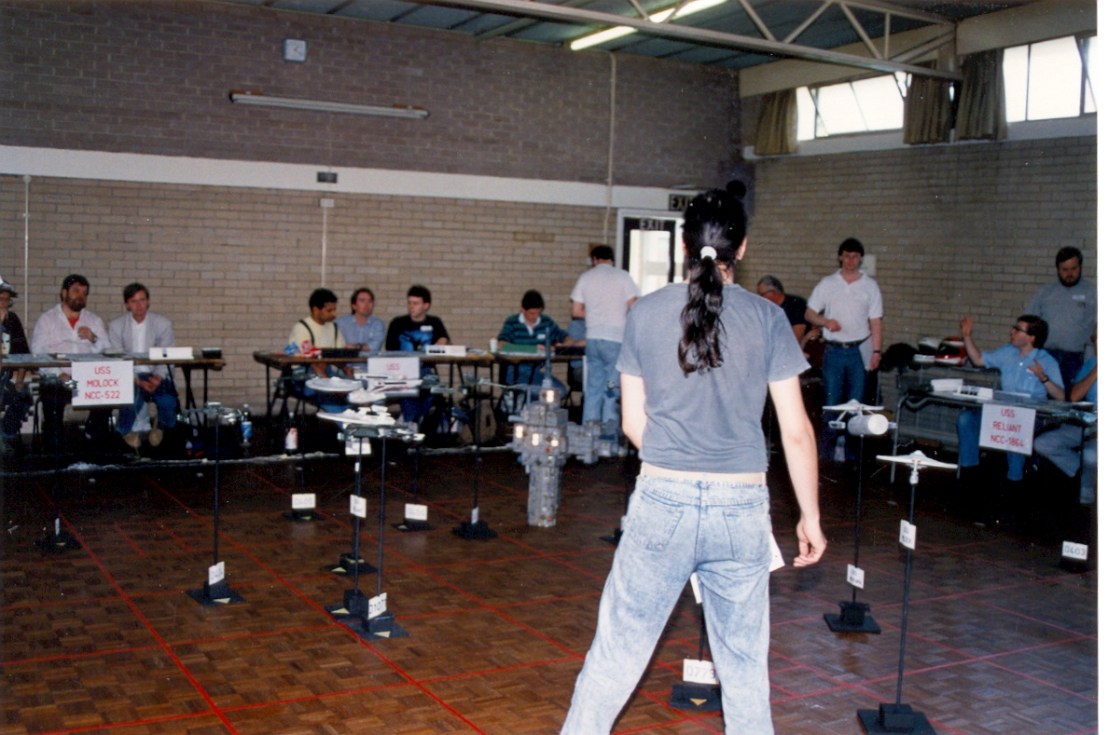
scan0008
‘Final Frontier’ SF Megagame – 1989

Management theory has also been an influence. There are vast mountains of books on management theory, and life would be far too short to have read them all, let alone apply them to megagame design. However, a number of ideas have been influential – in particular the very effective communications theories of MIT Professor Fred Kofman in his book ‘Conscious Business‘.  Don’t be put off by the ‘business’ look of the book, it is, for me, one of the best books on interpersonal communication out there.  And megagames are all about interpersonal communication.

Some basic ideas on the operation of hierarchies, team formation and even Maslow’s hierarchy of needs have been applied in the design of megagames.

Leadership and communications theory has been influential too. Megagames are about leadership. It will come as no surprise that theories of leadership have been influential in developing and designing game briefings and setting the challenges for players leading teams (even though they might not be aware that in playing what appears to be a fairly simple game role is in fact giving them access to valuable practice for leadership.)

 

Is it a megagame?

Just a short post this week.

I came across this chart I designed a few years ago now.
The final complete analytical flow chart will be more complex, of course – but as a starting point this was an interesting exercise.
I’m working on an updated version, so it would be very interesting to hear comments on how it might be improved or adjusted.

Anyone have any thoughts?

is-it-a-megagame

wargames
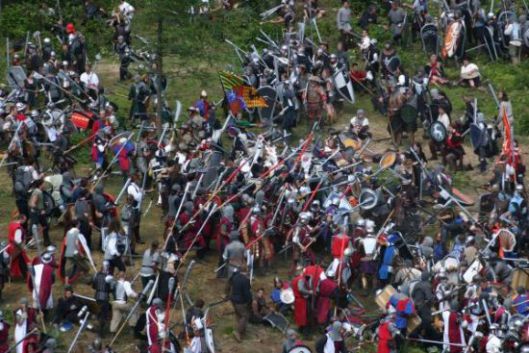
Is this a megagame? – discuss.
larp-battle
Or Is THIS a megagame?
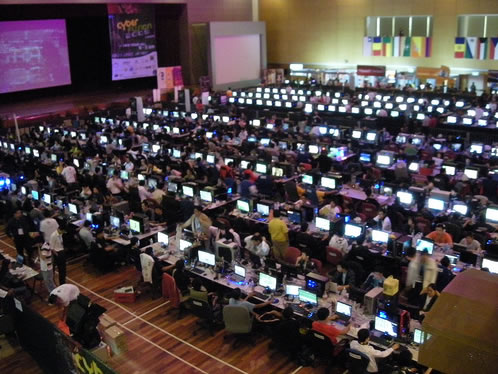
longest_lan_party_90191
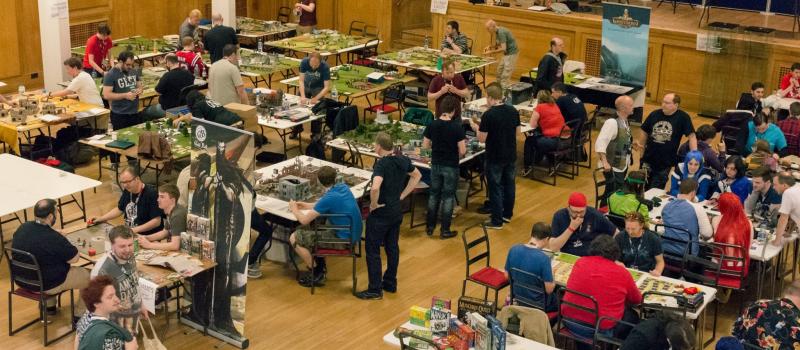
What about this?  Megagame or not?

Next Week : The Origins of Megagames

Reviewing and assessing how it went

Debriefing

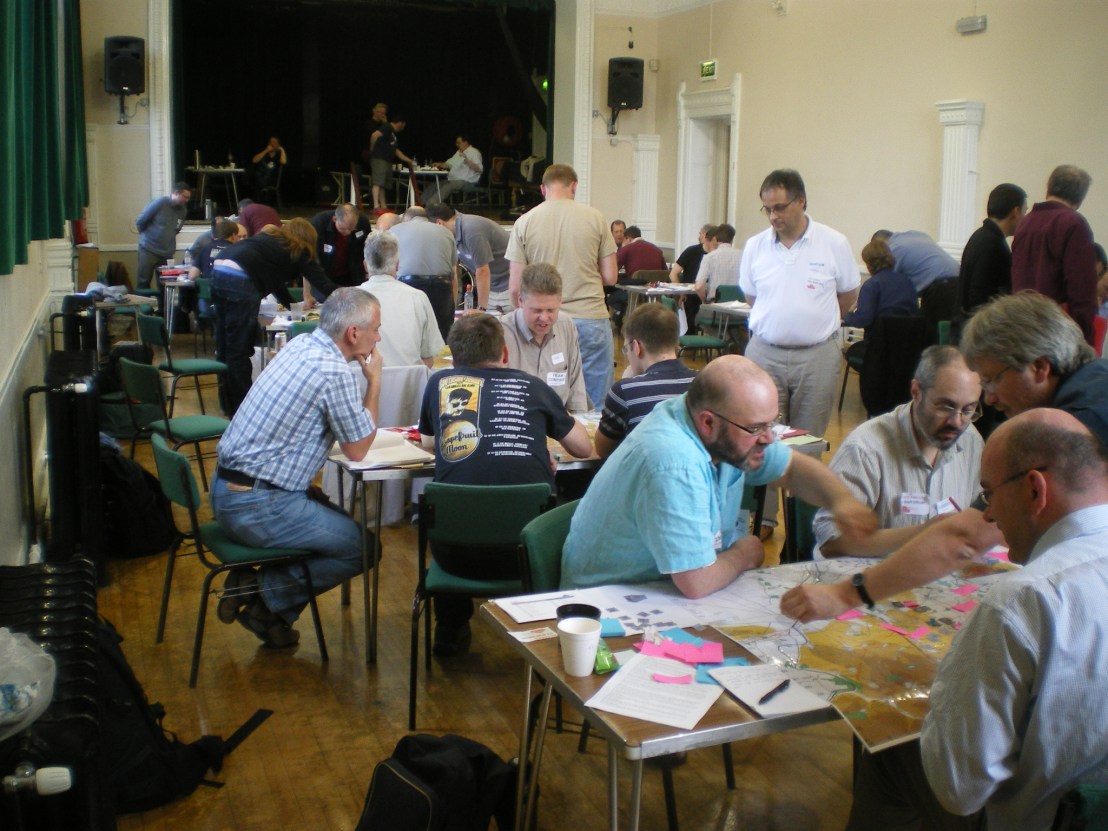
One of the most important traditions in megagaming is the post-game debriefing. It is really important that everyone gets together at the end for a short review of the game and to give and hear some feedback.
The format and timing of the post-game session will depend on the time available in the venue and the numbers of players and team.
Typically we allow about half an hour for the plenary debrief at the end, though it can be longer.
Ideally someone from each of the main player teams should be invited to give a short account of what their team anticipated for the day, their plan, and how it turned out. Encourage them to give one or two key points and to keep it short. Emphasise short, at the end of the game many players really want to give a blow-by-blow account of the day – avoid that if possible. And occasionally one gets players who just like the sound of their own voice!
We also ask some of the control team for their feedback – for example in a game with a main map, the Map Control might give an overview of events.
Also useful in closed games is to leave the master map open for a little while before clearing up so that players can take a look at what was really happening in their game.
The aim of the debrief at the end of the day is mainly to allow players to get a sense of some of the unfolding narrative that they would never know about otherwise.
We also encourage participants to write post-game After Action Reports (AAR) on the Megagame Makers Facebook group or on blogs. The post-game feedback from these sources is often really useful and it has the added benefit that megagamers who were not there get the chance to get a flavour of what they missed.

imgp1154

The Critique Sheet

The second main feedback tool we use is our Megagame Critique feedback form, This is a single sided questionnaire. We have used this fairly standard critique sheet for many years now, which has been very helpful in allowing us to compare subsequent runs of a game, or similar games.

The sheets are handed out at the end of the game, during the de-briefing session. We do this because we want the players to reflect a little on their day before filling it in. We also make a point of collecting the forms there and then. Experience has taught us that we lose a lot of feedback by waiting for someone to return a form later or respond on line. Also we want to be able to compare immediate responses to the game. If some respondents are giving the immediate reaction and some are reacting days or even weeks later they will have a different perspective.

Most of the key scores on the form are based on a 1 to 5 scale, and they are very helpful is getting an overall sense of how the game went.

In many cases, designers already know if a game went generally well or generally badly. What is harder to determine in a game involving many players interacting in widely different ways, if how everybody experienced the game. It is quite possible for a game to have gone generally well, and at the same time for a particular team to have had a miserable day. Psychologically, they will be disinclined to say this, especially if everyone else is chatting afterwards about how well the day went. The critique sheets not only provide a numerical measure, but also space for written comments and thoughts on the game. It is from these that we get a sense of where the ‘enjoyment black holes’ might be.
Sometimes this will be a result of game structure problems – a team might not have enough game interactions with other teams – sometime it can be as a result of the team’s own behaviours – i.e. they pissed off their other team members and nobody would talk to them thereafter. Or some combination of the two even.
It is important to hear these criticisms in a positive light – even if they are writing things like “…this was the worst game I ever played…”. Do not get defensive, read on – they might have some constructive suggestions that will make the game better – and as designers this is what we are always trying to achieve.
In our critique questionnaire we ask a number of key questions. There is nothing special about them, they just reflect what we’d like to know.
Of course, once you run a few megagames, the results have a value for rough comparison – though I would never go so far as to use the term ‘league table’ in polite company – it is something of an incentive to try to get an improving ‘Enjoyment ‘ score for your megagames.

The questions we ask are:

Part 1 : Numerically scored questions (participants score 1 to 5)

Game Briefing Materials: How well did the briefing material supplied enable you to play the game properly?
Rate of Play: To what extent were you under time pressure whilst playing? 5= too fast, and 1 = too slow
Personal Involvement: How much were you involved in the game action, or interactions with other players?
Personal Enjoyment: How much fun was it for you?
Game Difficulty: How hard you found the problems posed by the game and the situation you found yourself in?
Historical Feel: To what extent did the course of the game match up to what you would expect might happen historically?
Quality of the Control Team: The Control Team make the game run, how well or smoothly do you think they did this (so far as you could tell)?
Quality of Other Players: How well did you feel other players coped with the problems posed?
Admin Charge: To what extent do you feel you got value for money today?

Part 2 : Other questions, not numerically scored

Other Information

To help us to gauge what sort of background knowledge players come to the game with, answer the following by ticking the ONE box that most closely matches your background knowledge on the period in question:
[] Read only the game briefing material
[] Had a quick look at a book
[] Only one book on the subject
[] Several books on the subject
[] Studied the period/subject extensively

The Future

To gauge the likely take-up for future games (or re-runs of this game) please indicate below:
If this game were run again within 12 months, would you play again? YES/NO
If a game similar to this one were being organised, would you want to play? YES/NO

At the end of the form is space for the participant to offer suggestions, either on improvements to the game they have just played, or suggestions for future games.

imgp0621

Interpretation

There are some things we have noticed having review many of these feedback exercises.
Responses to game briefing materials seem to be independent of the actual quality or writing or production values We think this is usually related to how well the materials related to the player’s game role and ability to engage with the game.
Player involvement and player enjoyment are often linked.
The value for money question (Admin Charge) is also scored low when enjoyment is low.

The Real Debriefing

There is a third type of debriefing which I regard as essential after any megagame and that is the post-game social. What this is will depend on venue and timing – it can be as simple as naming your favourite local pub and everyone descends on that (remember to warm the pub first if its likely to be a lot of people), or you might be able to arrange something in the venue itself, or book a room at a restaurant. It all depends.
But whatever you choose it is important to have some sort of post-game event because this is where players really get to expand on their megagame war stories about who did what to whom and how often – and how they were shafted by their allies, or how they outwitted their enemies.

Megagames are primarily about a narrative arising from emerging gameplay and the post-game social session is, above all, the place where megagamers get to tell each other about that narrative.

dscf3393

NEXT WEEK : Is it a megagame?

The Megagame Control Team (Part 2)

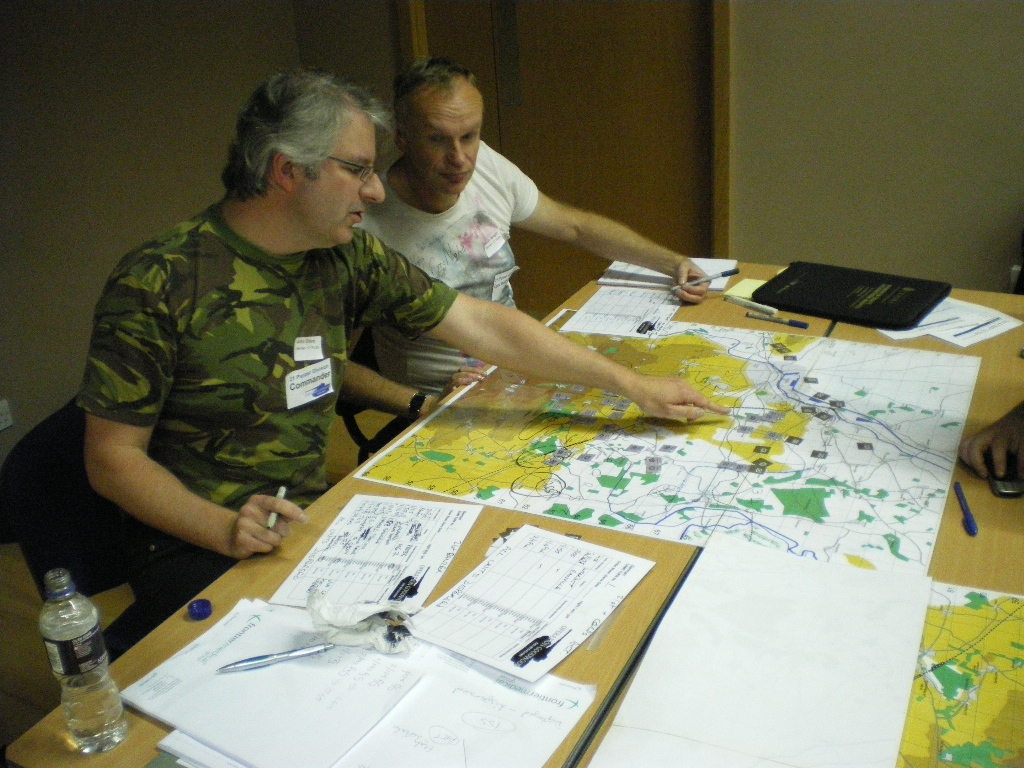
Map Control

Last time we looked at the work of the Team Controls in an operational megagame (or the operational part of a political/military megagame) and this is usually coordinated by one of more Map Controls. This is largely a management role. The key things Map Control usually takes on are:

Timing. As you have seen, Team Control has a full range of things to do, and whilst all Team Controls keep one eye on the clock it can be very easy to lose track of time, especially if you have a particularly confusing or knotty situation to resolve with other Team Control on the Master Map. Map Control will gently remind the Team Controls that they only have a few minutes to complete their updates. Map Control often holds the vital responsibility for overall game timing and ensuring things do not slip. In general this works, and the unbroken pace of time passing is one of the features of a well run megagame that distinguishes it from many other types of game.

Consistency – I have mentioned elsewhere the need for a common understanding of the principles and philosophy of the base game systems. Map Control is there to help the Team Controls with interpretations, or areas where they are not sure how to apply the base system. It is also important to make sure that any new rule interpretations are shared across the map with all the Team Controls, to ensure consistency.

Supporting Team Control – Sometimes, exceptionally, where Team Controls have a lot of actions to adjudicate, Map Control might step in and assist with the actual adjudication process – though this isn’t the norm. If Map Control is doing this then they are obviously not doing the rest of their task.

Troubleshooting – sometimes things get fraught or the Control Team come under time pressure themselves. This is less than ideal – the aim of megagame designs is that the time pressure should apply to the players, not Control. So Map Control – possibly in concert with the Game Designer, if present, takes on the authority to make greater changes – maybe dispensing with rule mechanisms that are slowing things down, or even, in extremis, leading a ‘free kriegsspiel’ of the map situation to unblock delays and sticking points. The most important thing here is that “the game must go on” and as far as possible appear seamless to the players. What goes on at the Master Map, stays at the Master Map so long as the output does not challenge the players’ willing suspension of disbelief.

Generally the Map Control will tend to be a more experienced member of the Control Team, with a good knowledge of the historical period, the game rules and good interpersonal skills. They need to be able to get the Team Controls moving constructively and show some gentle authority at the Master Map table.

imgp0128

Political Control

In some games we have a role for Political Control, which is there to facilitate useful conversations between political teams / players in a political or political / military megagame.

Generally a Political Control has a good knowledge of the politics of the period in play, and can extemporise on a theme of what might be possible or what the consequence of a particular political action might be. This is a lot more open ended than the Team Control role in an operational megagame, and requires consistent judgement and imagination to tell the story. This might be giving a player team the likely reaction ‘back home’ of a particular negotiation position or treaty, or it might be handling some sort of political skulduggery in historical periods where assassination or kidnapping was the norm.

The base rules generally provide guidelines on political actions, and might provide mechanisms for things like popularity, status or the chances of a successful assassination – but inevitably, players will come up with things outside these base rules or guidelines.
Political Control will often be keeping track of several political storylines simultaneously, as the results of player actions and decision work through into the political consequences (both intended and unintended).

In our megagames we tend to use only the most experienced Control team members for Political Control, mainly because they can always add depth to the basic game structure and are used to managing political wizard wheezes constructively and without unbalancing the overall game narrative.

Another important aspect of the Political Control role is representing higher authorities. In one run of our game about the 1940 Campaign in France and the Low Countries, the player playing Winston Churchill confessed after the game that we was genuinely nervous when the Political Control announced that the King wished to interview him about the (not very successful) course of the war so far, and then made him role-play the ‘awkward interview’ with the Political Control playing the King. This is a vital bit of colour – because it is very unusual for the top level commands to be entirely independent of their political masters. A ‘visit from Hitler’ in an East Front game will always concentrate high command players’ minds.

imgp1226

Non-Played Elements

In games with a wide range of actors that are not represented by player teams we generally have a Non-Played Elements (NPE) Control to manage this aspect of the game. The non-played elements might be minor countries in a political game that are too small to warrant an active player team, but which nevertheless have something to say in events. Famously one NPE Control managed to have an argument with himself while representing two minor countries, and went to war with himself over it! The key here is to add depth to the game and make those elements of the game not under player control have some life and be able to respond, as distinct from being merely blank areas on a map to occupy with no consequence. This creates a real sense of game depth that impacts on players’ decision making and their all-important sense of the game narrative.

NPE Control might also be role-playing certain personalities, and will often have a collection of these to do – maybe a Pope here or a minor Duke there. There will usually be base game rules to determine much of this – in the case of NPE that are countries the game might have rules determining their reactions to their neighbours or to being invaded – but ultimately players will value having someone to talk to face to face – even if all the minor rulers do look uncannily similar.

Specialised Control

Some games require different types of Specialised Control. These might be adjudicating logistics or strategic air power or religion or magic or births, ‘marriages and deaths’. These will vary very much from game to game and we often find that these will be built around some specific game mechanism. However they are usually far from mechanistic Control roles. Like Team Control and NPE Control players will always look for things outside the base game systems, and a Specialised Control has be able to take this and run with it – this is, one again, part of creating the impression of an ‘open world’ of the megagame – that anything could be done in real life can be done in the game.
For example a Logistics Control might be reporting back to logistics players information that is actually operational – say if the enemy have just appeared in the rear areas.
Or one division might be surreptitiously stealing fuel from another division’s dump.
Or in a fantasy game, the Mages decide they want to use their magic in a perfectly reasonable way that has not be allowed for in the rules – Magic Control has to come up with either a perfectly good reason why they cannot or, and better to my mind, quickly give them some possible outcomes (as well as costs and benefits).

Game Control

In overall charge of the game is Game Control. This can be either very easy or very difficult and it is always hard to know which in advance.
Game control has the following main areas of responsibility:

Game Flow. This is more a sense of the ‘feeling’ of the game than any structural or definable thing. If you stand and watch and listen in a megagame, you will be aware of the game ‘buzz’. This is a combination of the body language, the conversations, the movement around the room of a large number of gamers who are engaged with a game and enjoying themselves. The buzz varies with the mood of the players, the excitement of the game and the general energy in the room. If this starts to flag this is a clue that the game might not be holding everyone’s attention fully. This might be fine – it might be that last half-hour turn of the day and everyone is winding down. If it feels ‘flat’ during in the early afternoon then this is a clear indicator of game flow issues. There might be things that can be done at this stage – what, exactly, will depend on the game. If the game designer is present then they might have suggestions. It could be as simple as injecting additional resources for some teams (reinforcements, money, magic items). Or major like re-arranging the teams, or setting fresh objectives.

Timekeeping – as you have seen, Map Control keeps the Master Map to time (if there is one). Game Control has the wider responsibility for keeping the whole game moving, and this will often involve simple things like announcing turn changes. However there is more to it than that – where there are consistent delays – maybe a player team is consistently late getting their orders ready, or the Team Controls are too slow in getting back to the players, then it is Game Control’s to track down what is going wrong and fix it.

Looking after the players – this might be as simple as circulating and checking that everyone is have a good time (see below). Some players struggle, especially at first, and Game Control is, ideally, free to spend time chatting to them and helping them.

Supporting the Control Team – this is important when there are less experienced members of the Control team who might need reassurance or advice on how they are getting on. It might also be necessary to step in and relieve a member of the Control Team who has to drop out at the last minute or as a result of some crisis or other. Or better yet – reorganise the Control Team to cover problems, workloads etc.

Final Arbiter. The Game Control will be the last port of call for game problems. However, I always advise everyone in Control to watch out for players ‘shopping’ – that is, going to a series of members of the Control Team with the same question hoping to get the answer they want (I.e. the one that most benefits them) from one of them. In these cases I always ask “have you asked your Team Control?” first.

Anything not covered above. Stuff happens. Game control sorts it out. Game Control usually suits people who like to problem solve under pressure, and have good interpersonal skills.

dscf0777

The Game Designer and Control

In a slight majority of megagames the game designer is present.

This is both a blessing and a curse for Control.

The blessing is that the game designer is there and can help brief control on the game design philosophy, and even take part as a member of the Control Team (usually as Game Control, but not always). The game designer is also a very useful source of assistance where there are problems with the game mechanisms as they will, of course, be the ultimate authority on how the game should work – in theory at least.

There is an issue where there are patches or workarounds developed during gameplay – usually involving the Game Designer. It is very important that those patches are communicated to not only the Control Team but also the players (assuming it affects them).

Where the game designer can be a curse is where they feel the need to interfere when things are actually working well enough. This can be very disruptive for Control, especially if they have got into the flow of the game and feel they know what they are doing. Even if, or especially if, this might not be exactly what the game designer wrote, to the letter.

I’ve been guilty of this more than a few times myself as a game designer. Looking around the game I’ve been seized by a sudden panic that something isn’t working properly and have the uncontrollable urge to wade in a ‘fix it’. Only to be met by the Control Team who say “Jim … shut up … its all fine”. It is important that the game designer understand that with a good Control Team, they will come to you if there is a problem – you don’t need to interfere. In some cases where Control have made a workaround for something that didn’t quite work as well as hoped, you can usefully take notes for next time the game is run.

There can be an even bigger problem if the game designer actually plays in their own game. In my view, this is never a good idea, unless the game designer can be absolutely clear that they hold no responsibility for the game while its in play, and fully delegate responsibility to the Control Team.

Nobody on the Control Team wants to be ‘outranked’ by the game designer over some adjudication decision they have made that the game designer doesn’t like or on how the game ‘should’ be going.

That way lies madness.

 NEXT WEEK : Reviewing and assessing how it went