 Every game designer brings all sorts of experiences into their game designs, subject matter and the philosophy of their games, One of my earliest influences was being in the privileged position of having free access to the Ministry of Defence Whitehall Library during the later 1970s and early 80s. This library contained a huge collection of books on all manner of military subjects, many obscure and therefore deeply interesting (to me at least). Much of its collection was, sadly, sold off – the Admiralty Library part of the collection has moved to Portsmouth- and the remaining books are now part of the Defence Academy Library now I believe.
In among this were copies of RAND Papers on wargaming, political-military game and related subjects. Naturally, in those pre-internet days this was a gold mine of amazing material, not available to the general public, let alone to hobby gamers. As we would say nowadays “It quite literally blew my mind!”
Nowadays pretty much all of this is freely available on-line with only minimal searching – which is a brilliant opportunity for the new generation of game designers.
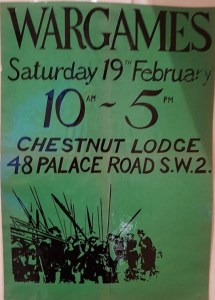 Access to this library, in conjunction with a group of enthusiastic fellow gamers, enabled me to experiment with ideas from the USA in ways not available to mainstream gamers then. I was particularly lucky in having a group of wargamers that formed the core of Chestnut Lodge Wargames Group to try out these ideas and approaches. And although at that time megagames had not yet become a thing – much of the thinking about multi-player, wargames or political / military games had its inception for myself and my circle of friends around that time.
Out of this came many game ideas – some examples of games arising directly out of the use of the MOD Whitehall Library being:
- A multiplayer double-blind map wargame for a 12 players or so on the battle for Kharkov played around 1980. By modern definitions, pretty much a proto-megagame. (I think I still have the typewritten materials somewhere – briefings duplicated by using carbon paper!).
- My WW2 brigade-level map based wargame rules STONK,
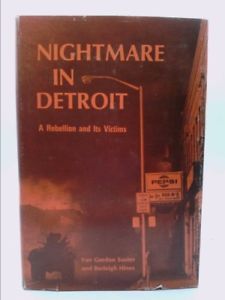 A map-based political / military game, using an obscure book called ‘Nightmare In Detroit’ describing the race riot in Detroit in 1967, that was first run for students at the Army Staff College Camberley at some point in the early 1980s. The ideas behind this game subsequently evolved over the following decades into the core of the megagame ‘Urban Nightmare’. (note: Thanks to the internet I now have my own copy!)
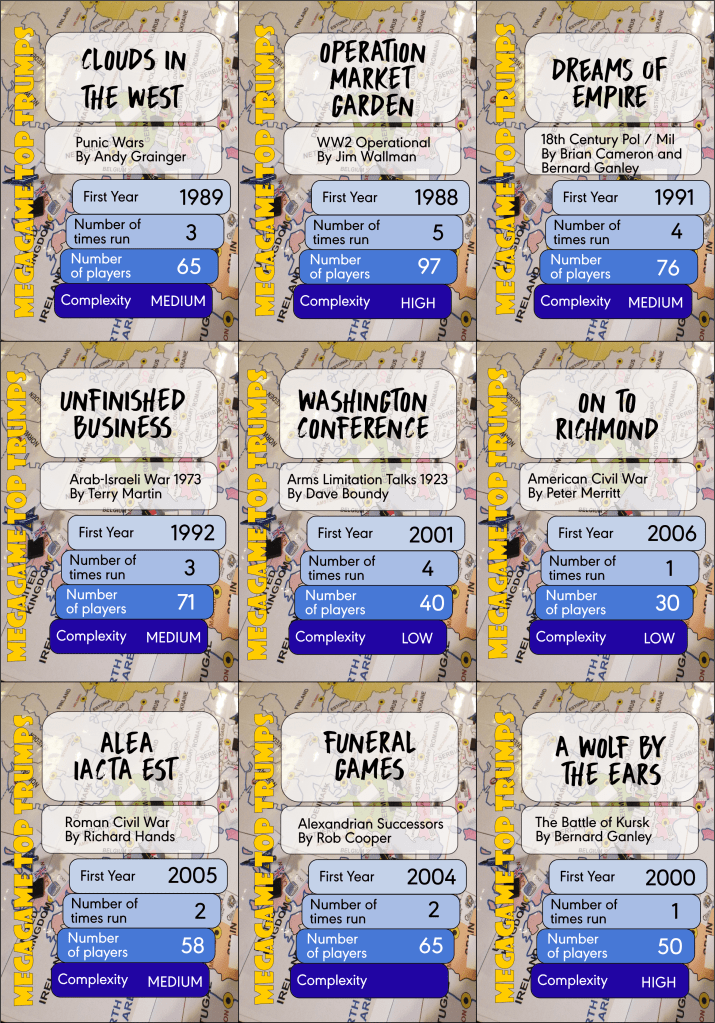
- My first serious operational megagame Operation Market Garden,
- My attempts at gaming revolutionary warfare as a play-by-mail game – the ‘Vietasia game’ I run with Paddy Griffith and others as players – of which nothing now survives as far as I know.
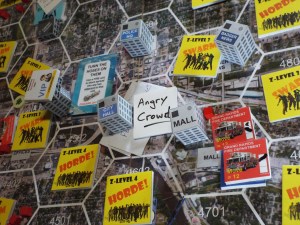
- My Civil Disorder Wargame, about rioting in city streets (the first version written about the time of the Brixton Riots in 1979).
 The big ideas in all of these that were startling for me as a young (and opinionated) wargamer were:
- Wargames do not have to be about toe-to-toe kinetic warfare between historical armies.
- Toy soldiers are fun, but ultimately they are only representational markers. The toys, counters, models you use are only useful to the extent that they are fit for the purpose of playing the game. Interestingly, this led to many mainstream wargamers insisting that I was ‘anti-toy soldiers’ as if that was a thing! 🙂
- It is possible to design a wargame about anything involving an adversarial situation. It might not necessarily be a war, or a battle, or involve armies.
- Maps are great!
 So for me libraries have been an important formative experience influencing my creativity and an opportunity to seize ideas. Of course now, I have access to pretty much any book, ever, via the internet. But – there is something about wandering around vast rows of shelves containing tens of thousands of print books and having one’s eye caught by a surprising book title – or be drawn out of curiosity by a dusty ancient volume languishing on a top shelf. Ideas that would never have come to you otherwise. Sometimes it is nothing – but the impact of serendipity on my game designs has been significant.
So if you get the chance of visiting a major library – any library – then do so – before they all vanish into the mists of the internet!
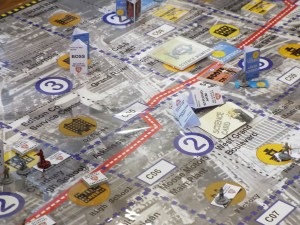 A megagame is like a board game because it often has a playing area (a map or game board), its has game components such as counters, cards, and tokens. And it has rules of the game that the players follow. It is not like a board game in that the rules of the megagame game are not immutable – the Control team can, and will , modify the game as it goes along to enhance player experience or respond to the emerging narrative. Megagames are also not like board games in that they rarely have fixed victory conditions that must be achieved to ‘win’. In fact ‘winning’ in the trivial sense is something that megagames cannot include by virtue of their size, scope, complexity and social nature. You cannot ‘win’ a megagame any more than you can ‘win’ going to a movie or ‘win’ attending a dinner party.
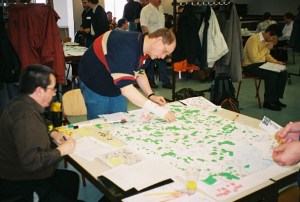 A megagame is like a wargame because it often has adversarial situations, and fighting or some sort of conflict represented. And by the formal definition of a wargame, most megagames are wargames. A megagame is not like a recreational wargame in that it will usually be much more fast-moving (certainly than most recreational wargames) and the rules and procedures much more broad-brush – effectively a synthesis of the main features of the tactical or strategic situation.
 A megagame is like a role playing game in that the players in it take on roles, often with specific characteristics and their game experience feels in many ways similar to a role playing game where they are playing a President or a General or an Alien Invader. A megagame usually differs from the more usual role playing game in that, like the wargame, there is a lot less character specific gamification (character statistics, experience points, skills development etc). This is usually because in the time available it is hard to make those aspects of the role playing game meaningful in the game situation. Players in a megagame often have less freedom around the scope of their role than in a normal role-playing game. So in a megagame, the players are given a situation briefing which tells them what their objectives are (though obviously exactly not what they should do to achieve them). This contrasts with conventional role playing games where the players are in a more flexible situation and can pretty nearly freely choose how to develop their character , attitudes and objectives within their game theme.
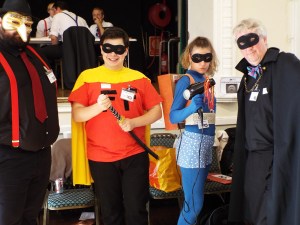 A megagame is like a LARP (very like a LARP) in the same way it is like a role playing game above. In megagames there is also the opportunity, that some take, to dress up for the part. It is with some reluctance that I generalise about LARPs but the main difference, it seems to me is that LARPs require dressing up and total immersion in a way that megagames do not and that the LARP follows a more pre-determined narrative structure, often with a clear ending or denouement. The creation of clear ending / grand finale aspect is quite literally impossible for the megagame – which is all about emerging gameplay – in a megagame the ending that emerges might be a single dramatic and memorable event, or it might be a collection of small events that contribute to the overall narrative.

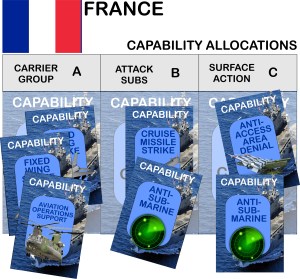 It all worked on the day, though interestingly the ‘professional wargamer’ audience had relatively little actually face to face game experience, and the environment made them, I think, a good deal more timid in their game play than recreational gamers tend to be.
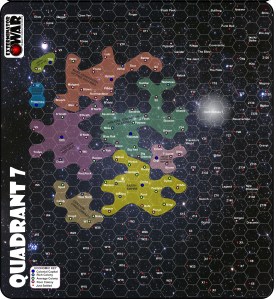 Then a trip to Cambridge to run Exterminator War, a science fiction political-military megagame based on a long-running role playing game I have been involved in. This was an interesting experience of translating a rich fictional universe into a game that would accessible to players without them having to read lengthy background briefings. It worked passably well, but a lot of lessons were learnt (or re-learnt) – mainly:
 No Game Survives ...